
In a new study due to be published on Astronomy and Astrophysics (A&A), postdoctoral researcher Pedro Figueira and his team successfully identified three massive planets orbiting two low-luminosity red giant stars, expanding our understanding of planetary systems around massive stellar hosts. The discoveries were made using 15 to 18 years of high-precision data collected by the CORALIE spectrograph as part of the CASCADES long-term observing campaign.
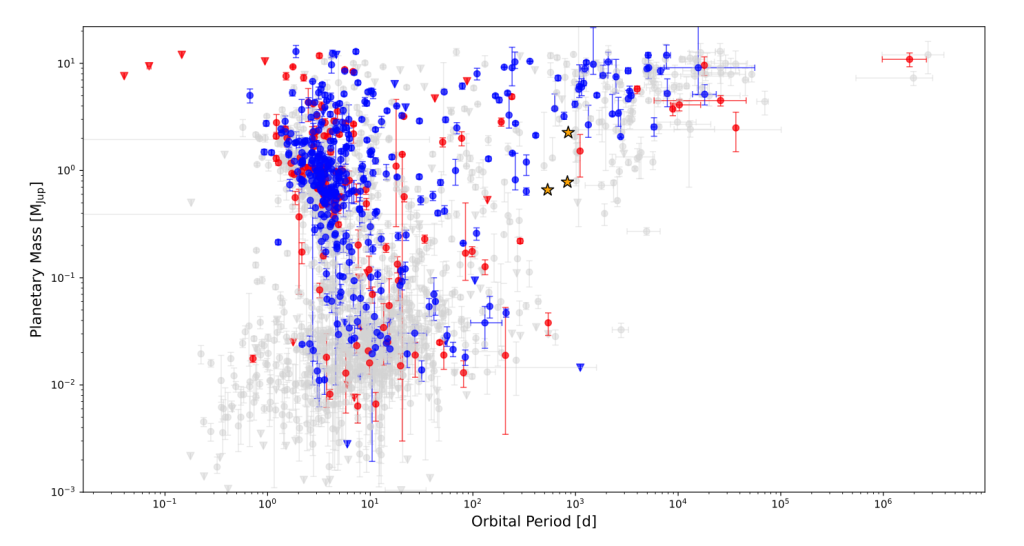
The newly discovered planets are gas giants located in a region of space where planets around this type of massive star are rarely found. Specifically, the team identified a massive planet (2.26 Jupiter masses) orbiting the star HD 125136 every 850 days. Additionally, they uncovered a two-planet system orbiting the star HD 127195, consisting of worlds with 0.66 and 0.78 Jupiter masses on orbits of 535 and 834 days, respectively. These findings help astronomers understand the properties of planets that can be formed around stars more massive than the Sun and how planetary systems evolve as their host stars grow old and expand.
Reflecting on the importance of these findings, Dr. Figueira remarked:
Searching for and detecting planets around stars more massive than the Sun shows how planet formation can work in different scenarios.
Beyond the exciting discoveries, the research explores techniques to overcome stellar pulsations—a common obstacle when searching for planets around giant stars. By testing a dedicated observing strategy on HD 127195, the team proved that these disruptive stellar «noise» signals can be efficiently filtered out to less than 5 meters per second.
This method allows us to reduce the effect of pulsations on the radial velocities, and will in the future allow us to detect lighter planets.
Dr. Pedro Figueira
Read the full paper here.
THIRSTEE (Tracking Hydrates In Refined Sub-neptunes to Tackle their Emergence and Evolution) is a groundbreaking project based at the Institute of Astrophysics of Andalusia (IAA-CSIC) and fully funded by an European Research Council (ERC) Horizon Starting Grant. The group focuses on the study of sub-Neptunes—the most common planets in the Galaxy—by combining transit photometry, high-precision radial-velocity observations, and atmospheric characterization within a novel statistical framework to uncover the origin, compositions, and architectures of these unique planetary systems. This research also acknowledges financial support from the Severo Ochoa grant CEX2021-001131-S.
Deja una respuesta