
The study, part of a thesis directed by Rafael Luque, has just been published in Science
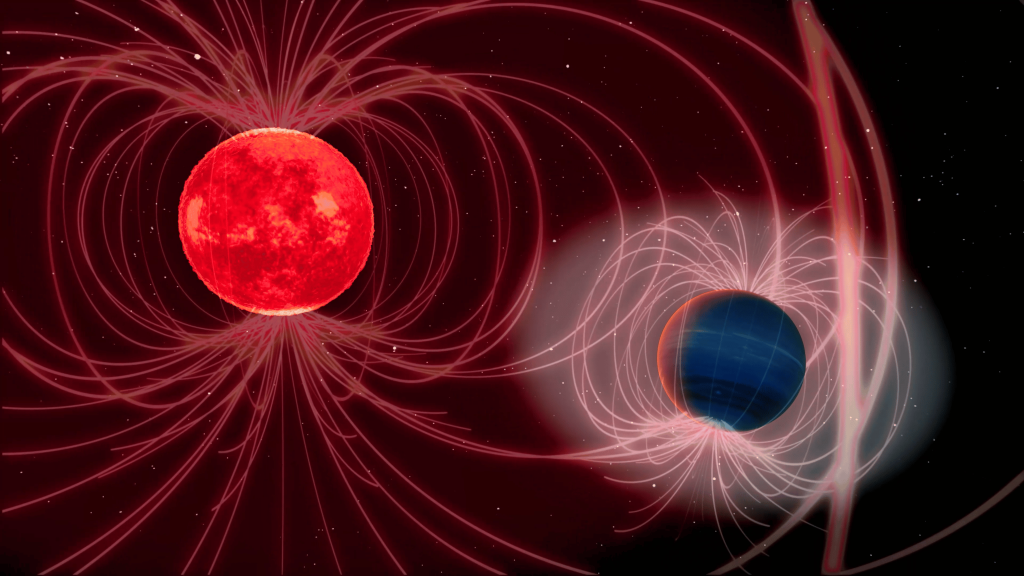
Analysis of 16 years of data collected on the GJ 436 planetary system has demonstrated, for the first time, that the behavior of a star outside our solar system can be altered by the influence of one of its orbiting planets. Specifically, the research focused on GJ 436 b, a Neptune-like exoplanet that orbits very close to its star. Scientists successfully estimated both the existence and strength of its magnetic field, providing the key to explaining the observed variations in the host star.
“In particular, we have observed that GJ 436 b produces regular variations in the star’s emission at specific wavelengths,” explains Daniel Revilla, a researcher at the IAA-CSIC. “Until now, measuring the magnetic field of an exoplanet was not possible. This property is key to knowing whether a planet can protect its atmosphere and, ultimately, whether it could sustain habitable conditions”.
Speaking about the discovery, Dr. Rafael Luque said: “Until recently it was thought that it was mainly the star that influenced the planet, but our results provide the first conclusive evidence to date of something that was already suspected: that the opposite can also happen and that a nearby planet can alter the environment of its star”.
Observations obtained with the CARMENES spectrograph—an instrument co-led by the IAA-CSIC and installed at the Calar Alto Observatory (CAHA)—and HARPS, reveal that the magnetic field of GJ 436 b interacts with that of its star and injects energy into the chromosphere, one of the upper layers of its atmosphere, increasing its activity. This process generates a phenomenon comparable to terrestrial auroras, but on a stellar scale.
This finding opens a unique opportunity to study the magnetic fields of planets outside our solar system. Studying these magnetic fields can help us understand how planets retain their atmospheres, probe their internal structure, and trace their long-term evolution.
Deja una respuesta